The Jump Host feature in Remote Desktop Manager connects to a remote host, often called a jump box, service host, or bastion server, which in turn connects to other hosts. In other words, Remote Desktop Manager's Jump feature allows for an RDP session in an RDP session. Remote Desktop Manager communicates with the jump host over a secure channel within the RDP session. The jump host then initiates the final session to the destination system.
This can be compared to RD Gateway from Microsoft and, to some extent, SSH port forwarding.
In Remote Desktop Manager 2026.1 and later, jump hosts support coexistence between the legacy RDM Agent-based jump mechanism and the new Devolutions Agent-based method.
Devolutions Agent: recommended mode going forward.
Legacy: the original RDM Agent executable packaged with RDM.
Automatic: attempts Devolutions Agent first and falls back to Legacy if needed.
The jump feature does not bypass Microsoft licensing limits for more than two concurrent RDP sessions. To support additional connections, you must install the Remote Desktop Session Host role and purchase per-user RDS CALs. For details, see Microsoft: Activate the Remote Desktop Services license server.
Remote Desktop Manager must be installed on the jump host. The application does not have to connect to any data source, as RDM only serves as a shell to facilitate jump operations.
For Devolutions Agent mode, ensure the jump host is running RDM 2026.1+ and Devolutions Agent 2026.1+. If it is running an older version (for example, 2025.3), jump operations may fail silently.
If using the legacy RDM Agent-based jump then the executable must be currently executing in a Windows session on the remote host, and set to automatically start upon login.
Devolutions Agent is deployed separately than the previously Remote Desktop Manager packaged RDM Agent.
MSI for direct deployment or integration with software management platforms
Chocolatey for command-line installation with WinGet coming soon
This allows you to have a strict firewall policy that allows connections only from a specific IP address. This configuration only grants you access to hosts that are accessible from the Jump Box. Imagine you have the following infrastructure:
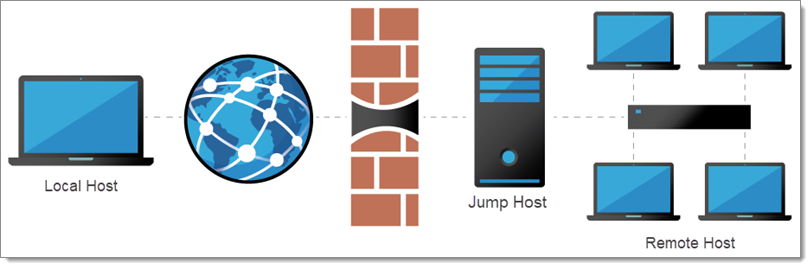
You need to access the remote hosts, but you want to limit risks and expose only the Jump Host to the internet traffic. This allows you to create strict firewall rules and to open only a single port. Therefore, it forces you to connect to the Jump Host before hopping to a remote host.
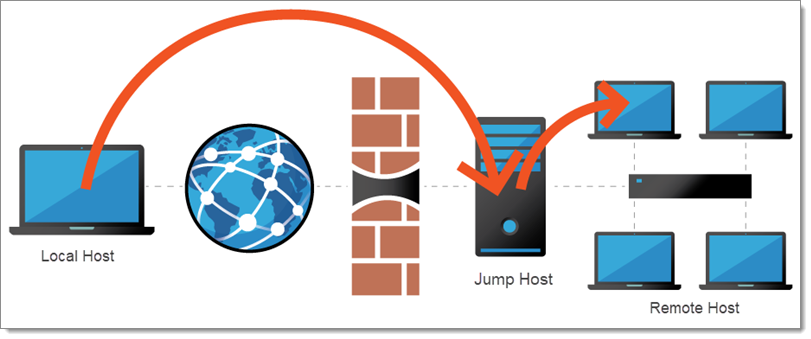
Remote Desktop Manager's Jump feature helps achieve that goal simply and efficiently.
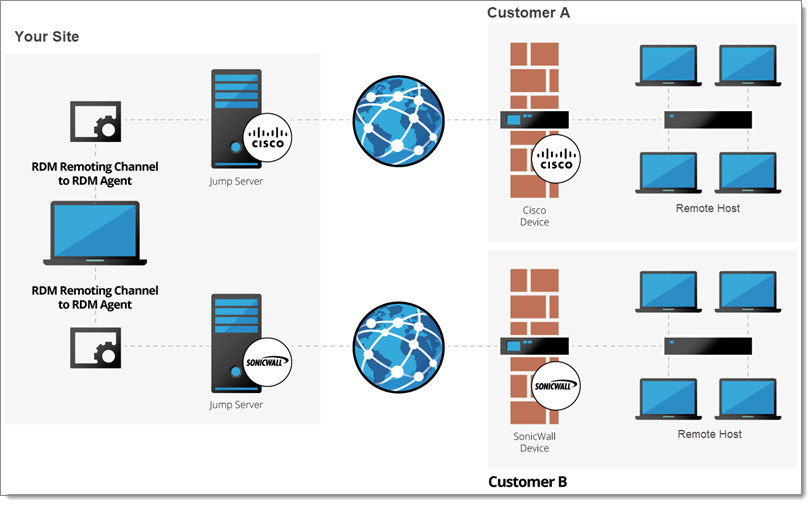
These limitations make it impossible to use multiple VPN clients concurrently on the same workstation. In this case, you can have multiple virtual machines, each running a single VPN client. Using these virtual machines as jump boxes allows you to connect to the virtual machine, launch the VPN client, and then launch the remote session.
-
Create an RDP entry for the Jump Host.
-
Fill the entry with a Name, Host and the Credentials.
For jumps to work, you need to supply the credentials via the Jump Host session. If the RDP sessions prompt you for the credentials after the start, the jump will fail.
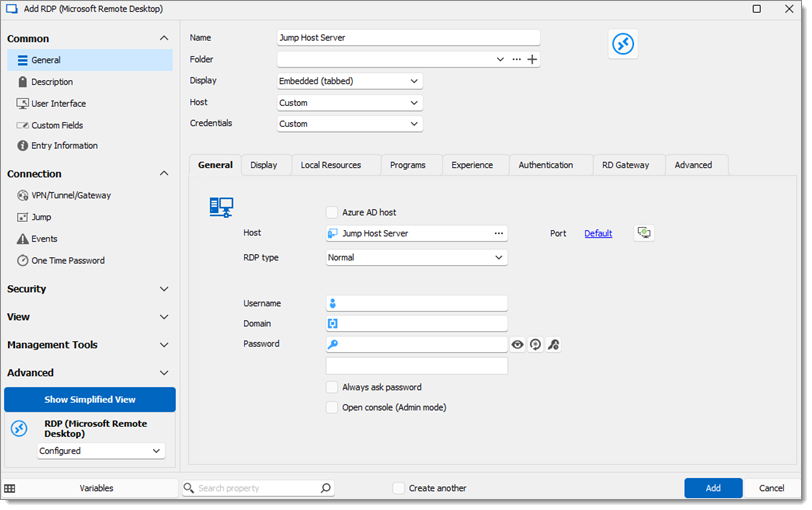
Create an RDP entry for the Jump Host -
In the Jump Host section, check Is Jump host.
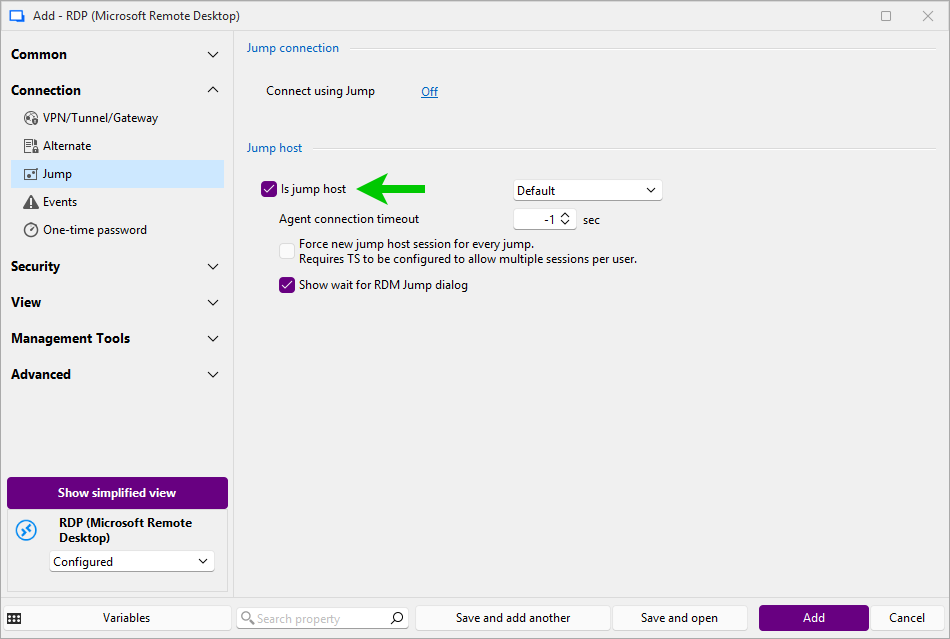
Check Is Jump host Show wait for RDM Agent dialog must be unchecked if your entry requires user interaction to open for any reason. If not, the jump will fail.
-
Click OK.
-
Launch the Jump Host session.
-
Install Remote Desktop Manager on the Jump Host.
The Jump Host acts as a relay between the local and the remote systems, allowing to use the Remote Desktop Manager license that has been used on the local workstation to register the application on the Jump Host.
Install Remote Desktop Manager on the Jump Host, perform your first jump and Remote Desktop Manager will be unlocked/licensed automatically via the jump communication/handshake.
There is no need to create a data source on the Jump Host. Remote Desktop Manager will open for the first time with a default SQLite Local Data Source. This is sufficient because the application on the Jump Host only acts as an intermediate between the local and the remote hosts.
-
Confirm Remote Desktop Manager Agent is started and set to Auto Start.
Auto Start must only be activated for the Remote Desktop Manager Jump agent or Remote Desktop Manager but not for both. In the case where Remote Desktop Manager is set to Auto Start please make sure to delete the shortcuts form either/both the following locations:
Run: shell:startup
Run: shell:common startup
-
Go to Tools - More Tools.
-
Select Remote Desktop Manager Jump.
-
Click OK.
-
Click Yes.
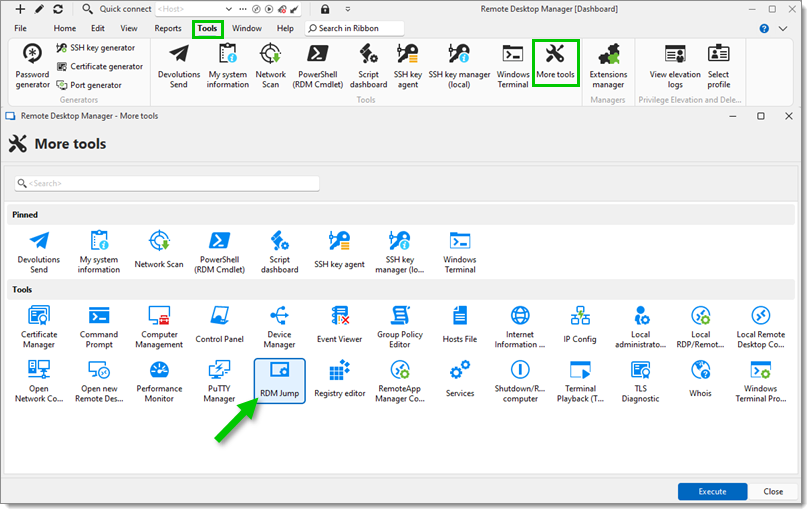
Select Remote Desktop Manager Jump
-
Right-click the Remote Desktop Manager Jump icon in the taskbar, and check Auto Start.
-
Adjust the user interface of the Jump Host to maximize the area to display remote sessions.
Make the application full screen.
Hide the Navigation pane in the View tab.
Hide the Ribbon in the View tab.
To show the Ribbon again, click the Remote Desktop Manager icon at the top left corner.
To reset the layout, in the Window tab, click Reset Layout.
The Jump Host is ready to use.
-
Create an RDP entry, on the local Remote Desktop Manager instance.
-
In Properties – Connection – Jump, set the Jump Host by clicking on the off button next to Connect using Jump.
-
The Jump Host can be Inherited if it is defined in the parent folder.
-
You can also choose a specific Session to point directly to the Jump Host entry.
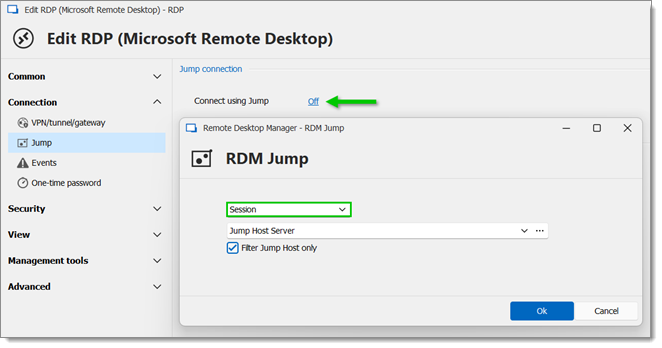
Link a session to a Jump Host entry
-
-
Click OK twice.
-
Launch the RDP session.
Start the RDP session of the Jump Host Server.
Wait for the Remote Desktop Manager Jump agent to connect.
On the RDP tab, right-click Agent Status. Remote Desktop Manager Jump should be connected.
Keep the RDP tab open.
Start the Jump session. Jump session should start on the Jump Host Server.
Close all sessions.
Start the Jump session directly. Jump Host Server and Jump session should both start.
All should be working correctly. If any of the steps fail, it is where you need to investigate.
To gain more space for the dashboard, in the View tab, hide the Ribbon and Navigation pane since the menus are not needed.
Use the same Remote Desktop Manager license on the local and the remote instances. The Jump Host acts as a relay between the local and the remote systems, allowing to use the Remote Desktop Manager license that has been used on the local workstation to register the application on the Jump Host.
There is no need to create a data source on the Jump Host. Remote Desktop Manager will open for the first time with a default SQLite Local Data Source. This is sufficient because the application on the Jump Host only acts as an intermediate between the local and the remote hosts.
Session focus synchronization: the selected session in your RDM client can follow the session focus on the Jump host, but only when using the Devolutions Agent method.
To run scripts on jump hosts with Devolutions Agent, right-click on the session and choose Devolutions Agent → Execute Script.
The Jump feature in Remote Desktop Manager offers a simple and efficient way to manage all your sessions including both jump hosts and internal machines within a single data source. It works by connecting to a remote host (commonly referred to as a Jump Box, Service Host, or Bastion Server), which then connects to other internal systems. This approach is similar to using an RD Gateway or SSH port forwarding.
Getting started with the Jump feature is straightforward. Once you've completed the configuration (instructions are provided at the end of this article), just launch the Jump connection. Remote Desktop Manager macOS will automatically initiate the RDP session to the jump host, followed by the session to the internal machine — all seamlessly. Even better, both sessions are logged directly to the data source, keeping your audit trail complete.
There are two scenarios in particular when using a Jump Host comes in really handy:
This allows you to have a strict firewall policy that allows connections only from a specific IP address. This configuration only grants you access to hosts that are accessible from the Jump Box. Imagine you have the following infrastructure:
You need to access the remote hosts, but you want to limit risks and expose only the Jump Host to the internet traffic. This allows you to create strict firewall rules and to open only a single port. Therefore, it forces you to connect to the Jump Host before hopping to a remote host.
The Jump feature helps achieve that goal simply and efficiently.
These limitations make it impossible to use multiple VPN clients concurrently on the same workstation. In this case, you can have multiple virtual machines, each running a single VPN client. Using these virtual machines as jump boxes allows you to connect to the virtual machine, launch the VPN client, then launch the remote session.
Note: The Jump feature for Mac is built into the Remote Desktop Manager macOS app. It requires an Remote Desktop Manager Jump agent to be installed on the Jump or Bastion server, and a full installation of Remote Desktop Manager macOS on the local machine and the jump host.
Create a new RDP entry for the jump host.
In the General side menu, enter a name for the session
In the RDP side menu, enter the host name and credentials.
In the Jump Host side menu, check the option Is Jump Host.
The session is now ready to be configured to use the Jump Host.
In the local Remote Desktop Manager macOS instance, create a session entry as usual.
Set the jump host by selecting the Jump Off button. The Jump Host can also be inherited if defined in the parent folder.
Now simply launch your session. Think of it like a session within a session.
 Share your feedback